As a supplier of heavy – duty welding robots, I’ve encountered numerous inquiries regarding the torque requirements for the joints of our robots. These requirements are crucial as they directly impact the robot’s performance, precision, and overall durability. In this blog, I’ll dive into the torque requirements for the joints of heavy – duty welding robots, exploring the factors that influence them and why it matters. Heavy-Duty Welding Robots
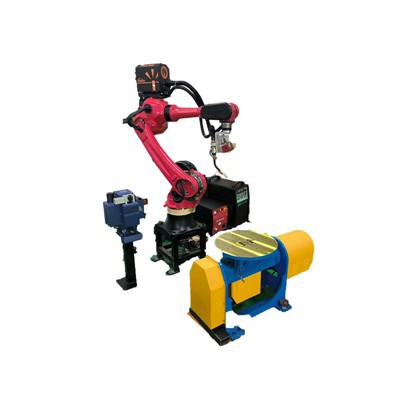
Understanding the Role of Torque in Welding Robots
Torque, in simple terms, is the rotational force that causes an object to rotate around an axis. In the context of heavy – duty welding robots, joints are the areas where rotation occurs. Each joint’s torque is responsible for moving the robot’s arm segments to perform different welding tasks, whether it’s reaching a specific spot on a large workpiece or executing complex welding paths with high accuracy.
Proper torque at the joints guarantees that the robot can handle the weight of the welding equipment (such as welding torches, cables) and the forces generated during the welding process without any compromise in its path accuracy. In a high – precision welding job, even a slight deviation due to insufficient torque can lead to defective welds, which are costly and time – consuming to correct.
Factors Influencing the Torque Requirements
1. Payload
The payload is one of the most significant factors affecting the torque requirements. A heavy – duty welding robot often needs to carry not only its own end – effector (the welding torch) but also additional equipment like sensors, wire feeders, and in some cases, coolant systems. These added components increase the mass that each joint needs to support and move. For example, in an automotive manufacturing plant, our robots are often required to hold large and heavy welding fixtures. The greater the payload, the higher the torque needed at the joints to maintain smooth and precise movement.
2. Range of Motion
The range of motion of the joints also plays a key role. Heavy – duty welding robots typically need to perform complex and diverse movements. Some joints may need to rotate a full 360 degrees, while others may need to move in multiple planes to access different parts of the workpiece. When a joint has a large range of motion, it requires more torque to start and stop the movement accurately. For instance, in large – scale pipeline welding, the robotic arm needs to move around the circumference of the pipe, which demands high – torque values at the relevant joints to ensure continuous and stable operation.
3. Speed of Operation
The speed at which the robot operates impacts the torque requirements as well. Faster movement requires more torque to accelerate and decelerate the robot’s arm segments. In high – volume production environments, where welding robots need to complete tasks quickly, they often operate at higher speeds. For example, in the production of consumer electronics enclosures, robots are set to perform high – speed spot – welding operations. To achieve such high – speed performance, the joints need to be able to generate sufficient torque to handle rapid changes in velocity.
4. Welding Forces
During the welding process, various forces are exerted on the robot’s arm. These forces include the reaction forces from the molten metal, the forces from the wire feeding mechanism, and the forces generated by the arc. For example, in arc – welding applications, the arc itself can create reactive forces that push against the welding torch. To counteract these forces and keep the welding torch in the correct position, the joints of the robot need to have enough torque. In some heavy – duty welding scenarios, such as the welding of thick – walled steel structures, these forces can be quite substantial, necessitating higher torque values at the joints.
Calculating the Torque Requirements
Calculating the exact torque requirements for the joints of heavy – duty welding robots is a complex process that involves a combination of theoretical analysis and practical testing.
Theoretical analysis starts with identifying the mass and inertia of the moving parts. By using principles of mechanics, engineers can calculate the forces and torques based on the desired motion profiles, such as acceleration, velocity, and position. For example, the moment of inertia formula (I = \sum_{i}m_{i}r_{i}^{2}) is used to calculate the inertia of each arm segment, where (m_{i}) is the mass of the (i) – th part and (r_{i}) is the distance from the axis of rotation.
However, due to the real – world complexity of welding operations, practical testing is also essential. We often conduct extensive field tests in different welding applications to validate and adjust the torque requirements. During these tests, we measure the actual forces and torques using sensors installed at the joints. This data is then used to fine – tune the robot’s control system and ensure that the joints can withstand the demands of the specific welding tasks.
Why Accurate Torque Requirements Matter
Ensuring the correct torque requirements for the joints of heavy – duty welding robots has several benefits.
First, it improves the quality of the welds. When the joints have sufficient torque, the robot can maintain a stable and accurate welding path, which leads to consistent and high – quality weld beads. This is especially important in industries such as aerospace and automotive, where the quality of welds can directly affect the safety and performance of the final products.
Second, it enhances the robot’s reliability and longevity. If the joints are under – torqued, they may experience excessive wear and tear, leading to premature failure. On the other hand, over – torquing can also cause damage to the mechanical components and increase energy consumption. By accurately determining the torque requirements, we can optimize the robot’s performance and reduce maintenance costs.
Finally, it increases productivity. Robots with the right torque at the joints can operate more efficiently, performing tasks at the desired speed and accuracy. In a production line, this means fewer defects, less downtime for rework, and higher overall output.
Meeting the Torque Requirements in Our Heavy – Duty Welding Robots
As a supplier, we take several steps to ensure that our heavy – duty welding robots meet the appropriate torque requirements.
We use high – quality motors and gearboxes that are specifically designed to provide the necessary torque. These components are carefully selected based on the expected payloads, range of motion, and speed requirements of the robots. Our engineering team also conducts in – depth simulations and calculations to optimize the design of the robot’s joints, ensuring that they can generate the required torque with minimum energy consumption.
In addition, we offer customization options for our customers. Different welding applications have different torque requirements, and we understand that a one – size – fits – all approach may not work. We work closely with our clients to understand their specific needs, and then tailor the robots’ joints to meet those requirements. This may involve adjusting the motor power, changing the gear ratios, or modifying the mechanical structure of the joints.
Conclusion
The torque requirements for the joints of heavy – duty welding robots are a critical aspect of their design and operation. Payload, range of motion, speed of operation, and welding forces all influence these requirements. By accurately calculating and meeting the torque needs, we can improve the quality of welds, enhance the robot’s reliability, and increase productivity.
Welding Robot If you’re in the market for heavy – duty welding robots and want to learn more about how our products can meet your specific torque requirements, we’d be more than happy to have a discussion with you. Contact us to start a conversation about your procurement needs and let us help you find the perfect welding solution for your business.
References
- Norton, R. L. (2012). Design of Machinery: An Introduction to the Synthesis and Analysis of Mechanisms and Machines. McGraw – Hill.
- Craig, J. J. (2005). Introduction to Robotics: Mechanics and Control. Pearson Prentice Hall.
Dongguan Chuanglida Intelligent Equipments Co., Ltd.
Address: Room 201, Building 2, No. 61, Shachang 1st Road, Dalang Town, Dongguan City, Guangdong Province
E-mail: haoguangli001@outlook.com
WebSite: https://www.boruntestech.com/
